A remarkable archaeological discovery in York, England, is offering new insight into life, death, and family relationships during the Roman era. Researchers have identified traces of the legendary Tyrian purple dye in the burials of two infants who lived nearly 1,700 years ago, revealing evidence of extraordinary wealth and deep parental care.
The discovery has attracted international attention because Tyrian purple was one of the most expensive and prestigious pigments in the ancient world. Often associated with emperors, nobles, and members of the elite, the dye symbolized power, influence, and social status throughout the Roman Empire.
According to researchers, the infants were buried in luxurious textiles decorated with purple dye and gold thread, suggesting that they belonged to a wealthy and influential family living in Roman Britain.
What Was Tyrian Purple?
Tyrian purple was one of the most sought-after dyes of antiquity. Its name comes from the ancient Phoenician city of Tyre, located in present-day Lebanon, where the dye was first produced on a large scale.
Unlike modern dyes, Tyrian purple was created through an incredibly labor-intensive process involving marine mollusks known as murex snails. Thousands of snails were required to produce even a small amount of pigment. Workers extracted a secretion from the snails, which then underwent a lengthy process of treatment and exposure to sunlight before developing its distinctive purple color.
Because of the enormous effort involved in its production, the dye became exceptionally valuable. Historians believe that in some periods its price rivaled or even exceeded the value of gold by weight.
The color eventually became closely associated with political power. Roman emperors often wore garments dyed in Tyrian purple, and strict laws sometimes restricted its use to members of the highest social classes.
An Unexpected Discovery in York
The discovery was made during the examination of burial remains found in York, a city with a rich Roman history. Scientists analyzed fragments of textile recovered from infant graves and detected microscopic traces of the rare purple pigment.
Finding evidence of Tyrian purple is unusual in itself, but discovering it in infant burials is even more extraordinary. Organic materials such as textiles typically deteriorate over centuries, making the preservation of any chemical traces a rare occurrence.
Researchers were surprised not only by the presence of the pigment but also by evidence suggesting the textiles contained gold threads. These luxurious materials indicate that the infants were buried with exceptional care and respect.
The findings suggest that their family possessed considerable wealth and access to imported luxury goods that would have been unavailable to most people living in Roman Britain.
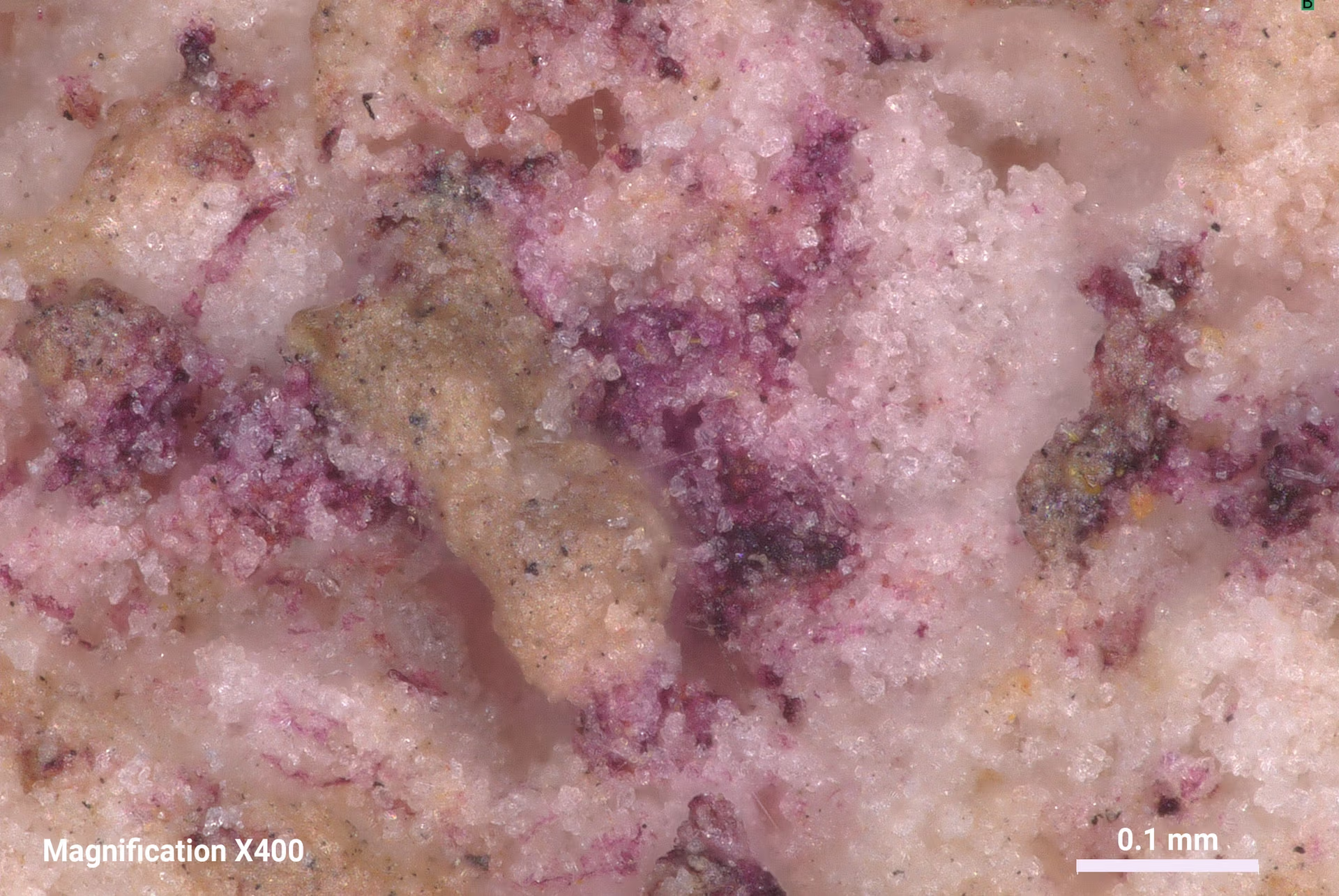
Credit: University of York / Seeing the Dead Project (or York Museums Trust collections)
York’s Importance in Roman Britain
To understand the significance of the discovery, it is important to consider York’s role during the Roman period.
Known as Eboracum under Roman rule, York was one of the most important cities in Britain. It served as a military headquarters, administrative center, and political hub for the northern provinces of the empire.
Roman legions were stationed there, and several emperors visited or resided in the city. In fact, Emperor Constantine the Great was proclaimed emperor in York in AD 306, making the city a key location in Roman history.
As a major center of trade and government, York was connected to extensive networks that stretched across Europe, North Africa, and the Middle East. Luxury goods, exotic materials, and valuable products moved through these trade routes, linking distant parts of the empire.
The presence of Tyrian purple in York demonstrates the reach of these commercial connections and highlights the city’s importance within the Roman world.
More Than a Story of Wealth
While the discovery provides evidence of high social status, archaeologists believe it also reveals something far more personal.
The elaborate burial arrangements suggest that the infants were deeply cherished by their family. The use of costly fabrics and prestigious dyes reflects a desire to honor and remember the children in death.
For many years, historians debated how Roman families viewed childhood. Because infant mortality rates were extremely high in antiquity, some scholars suggested that emotional bonds between parents and young children may have been weaker than they are today.
However, discoveries like this challenge that assumption.
The care invested in these burials indicates that parents experienced profound grief and loss when a child died. The luxurious materials used in the funeral rites suggest that the family sought to provide a meaningful and respectful farewell despite the children’s young age.
What the Discovery Tells Us About Roman Society
The findings offer valuable insights into several aspects of life in the Roman Empire.
First, they demonstrate the sophistication of Roman trade networks. A dye produced in the eastern Mediterranean was transported thousands of miles to Britain, one of the empire’s most distant provinces.
Second, the discovery highlights the vast differences in wealth and social status within Roman society. While many people lived modest lives, elite families had access to luxury products that symbolized prestige and influence.
Third, the burials provide a glimpse into family life and emotional relationships during the Roman era. Archaeological discoveries often focus on emperors, military campaigns, and monumental architecture, but these graves remind us that ordinary human experiences such as love, loss, and remembrance were just as important in the ancient world as they are today.
The Science Behind the Discovery
The identification of Tyrian purple was made possible through advanced scientific analysis. Researchers used modern laboratory techniques to detect chemical signatures left behind in the burial textiles.
Even though the fabric itself had largely decomposed, tiny molecular traces remained preserved within the soil and surrounding materials. These traces allowed scientists to confirm the presence of the famous purple dye centuries after the original textiles had disappeared.
The discovery highlights how modern technology is transforming archaeology, enabling researchers to uncover details that would have been impossible to identify only a few decades ago.
A Window Into the Past
Archaeologists believe the findings will contribute to a broader understanding of Roman Britain and the people who lived there. Every new discovery helps researchers reconstruct the social, economic, and cultural realities of life nearly two millennia ago.
For now, the infant burials stand as a powerful reminder that behind every archaeological artifact lies a human story. The luxurious purple textiles and privilege but also a family’s desire to honor and remember their children.
Nearly 1,700 years after these infants were laid to rest, their graves continue to tell a story that transcends time—a story of status, devotion, grief, and the enduring bonds between parents and their children.
Why Roman History Still Fascinates Archaeologists
Every archaeological discovery from the Roman era helps researchers understand how one of history’s largest empires functioned. The Roman Empire stretched across three continents and ruled an estimated 60–70 million people at its height.
Archaeologists continue to uncover evidence showing how Roman technology, trade, and culture spread far beyond Italy. Even locations that were never fully incorporated into the empire often adopted Roman goods, architecture, and customs through trade and cultural exchange.
This article is based on research conducted by archaeologists and scientists from the University of York and the Seeing the Dead project, along with reports published by archaeological and scientific media covering the discovery of rare Tyrian purple dye preserved in Roman infant burials in York, UK. The findings reveal evidence of high-status funerary practices and the use of one of the most valuable pigments of the ancient world, associated with imperial and elite Roman society.
Written by Hidden Civilizations Editorial Team