A remarkable archaeological discovery in Israel is giving researchers an unprecedented look into the lives of early humans who lived around 400,000 years ago. The recently explored cave, preserved for hundreds of thousands of years, has provided scientists with valuable evidence about hunting, tool-making, and the everyday activities of prehistoric communities.
Unlike many ancient sites that have been disturbed by natural events or human activity over time, this cave remained largely untouched. As a result, archaeologists have been able to study artifacts in their original locations, offering a much clearer picture of how early humans lived long before the rise of modern civilization.
Researchers believe the site could help answer important questions about human evolution and the development of increasingly complex behaviors during the Middle Paleolithic period.
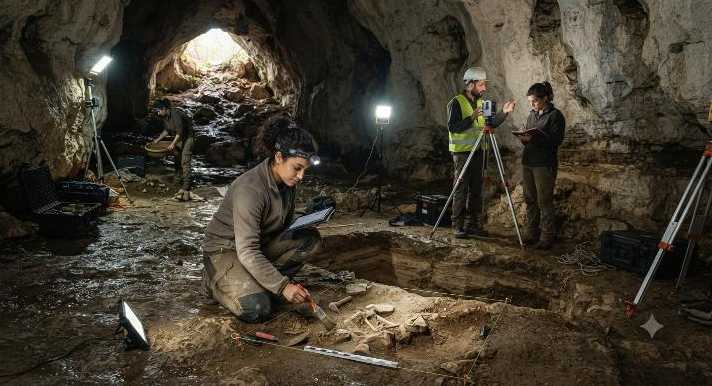
A Time Capsule From Prehistoric Times
The cave is considered one of the best-preserved archaeological sites of its kind. Layers of sediment protected the remains from erosion and outside interference, allowing scientists to examine thousands of years of human activity in remarkable detail.
Experts describe the discovery as a “time capsule” because it preserves evidence of repeated human occupation over an extended period. Instead of representing a single event, the cave appears to have been used by generations of prehistoric people who returned to the same location again and again.
This provides researchers with a rare opportunity to study how ancient communities adapted to their environment and developed survival strategies over time.
Sophisticated Stone Tools
Among the most significant discoveries are dozens of carefully crafted stone tools, including hand axes, scrapers, blades, and cutting implements.
According to archaeologists, these tools demonstrate that early humans already possessed advanced knowledge of stone-working techniques. Rather than simply breaking rocks to create sharp edges, they carefully selected raw materials and shaped them into specialized tools for different tasks.
The variety of artifacts suggests that prehistoric people understood which tools worked best for hunting, butchering animals, preparing hides, and processing wood.

Researchers say these findings highlight an important stage in technological development that eventually contributed to later human innovation.
Evidence of Hunting Activities
Excavations also uncovered numerous animal bones belonging to species such as deer, gazelles, and other wild animals that once inhabited the region.
Many of the bones contain clear cut marks made by stone tools, indicating that the animals were hunted and processed by humans. Scientists believe the cave may have served as a seasonal camp where hunting groups gathered after successful expeditions.
The evidence suggests that prehistoric communities were highly skilled hunters who understood animal behavior and the surrounding landscape.
Rather than wandering randomly, they likely returned to locations that offered shelter, access to fresh water, and nearby hunting grounds.
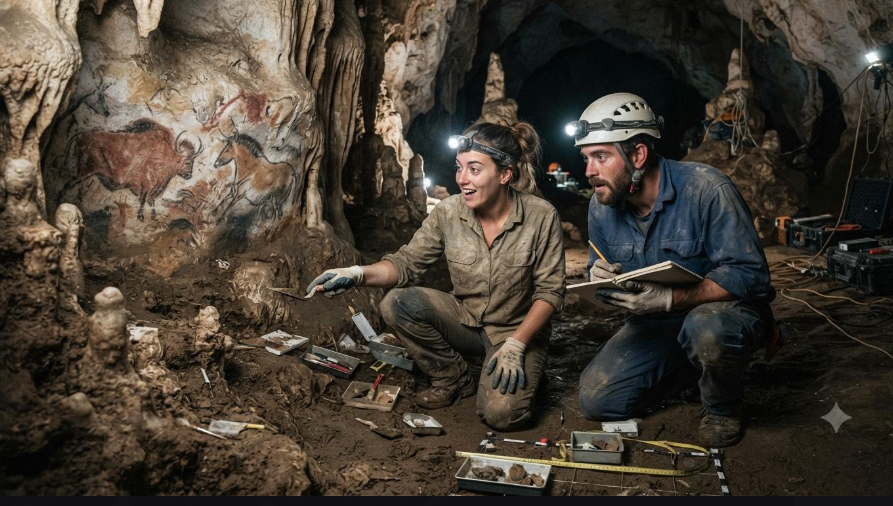
Two archaeologists reacting with excitement inside a dimly lit cave next to ancient rock wall paintings, carefully examining and cataloging newly discovered artifacts on the ground.
Signs of Controlled Fire
One of the most important discoveries inside the cave is evidence of controlled fire use.
Researchers found burned materials that indicate early humans were capable of maintaining fires instead of simply taking advantage of naturally occurring wildfires.
The ability to control fire marked one of the greatest milestones in human evolution. Fire provided warmth during colder seasons, protection from predators, cooked food that was easier to digest, and a gathering place where members of a group could spend time together.
Many anthropologists believe that regular fire use played a crucial role in human development by improving nutrition and encouraging stronger social interaction.
More Organized Than Previously Thought
The collection of artifacts suggests that these prehistoric people lived more organized lives than many scientists once believed.
The presence of different tool types, animal remains, and fire-related evidence indicates that various activities took place within the cave. Some individuals may have focused on hunting, while others prepared food, maintained tools, or cared for the fire.

Although researchers cannot determine every aspect of their social structure, the evidence points toward cooperation and shared responsibilities within small groups.
This challenges the outdated idea that early humans lived in a simple or primitive way. Instead, they appear to have developed practical knowledge and survival techniques that improved over generations.
Why This Discovery Matters
Archaeologists believe the cave fills an important gap in the story of human evolution.
The site dates to a period that remains poorly understood compared to later prehistoric eras. Every new artifact recovered helps scientists better understand how ancient populations adapted to changing environments and gradually developed more advanced technologies.
Because many of the archaeological layers remain intact, researchers can reconstruct activities with much greater accuracy than at heavily disturbed sites.
The discovery also demonstrates the importance of protecting archaeological locations before modern construction permanently destroys valuable evidence from the distant past.
More Research Is Still Ahead
Although the initial findings are already significant, archaeologists emphasize that only part of the cave has been excavated.
Future research will include laboratory analysis of stone tools, animal bones, charcoal remains, and soil samples. These studies may reveal more about the climate, food sources, migration patterns, and daily routines of the people who occupied the cave.
Scientists hope additional discoveries will provide new insights into one of the most fascinating chapters of human history.
Looking Back to Understand Our Origins
Every archaeological discovery brings researchers one step closer to understanding how humanity evolved over hundreds of thousands of years.
The newly explored cave in Israel offers a rare opportunity to examine the lives of early humans through exceptionally well-preserved evidence. While many questions remain unanswered, the findings reveal that prehistoric communities were resourceful, adaptable, and capable of developing sophisticated survival strategies long before recorded history.
As excavations continue, researchers expect this remarkable site to play an important role in expanding our knowledge of the ancient world and the long journey of human evolution.
This article is based on reporting by CNN and information released by the Israel Antiquities Authority and researchers from the University of Haifa regarding the prehistoric cave discovery in northern Israel.
Written by Hidden Civilizations Editorial Team