Mexico is one of the world’s leading countries in archaeological discoveries, with thousands of ancient sites and artifacts, such as Chichen Itza, Teotihuacan, Palenque, Monte Albán and Tulum.
Many experts believe that thousands of archaeological treasures in Mexico remain undiscovered.
Archaeologists exploring an underwater cave system in Mexico’s Yucatán Peninsula have uncovered human remains estimated to be more than 8,000 years old. The remarkable discovery offers new insights into some of the earliest inhabitants of the Americas and sheds light on how ancient people lived during a period of significant environmental change.
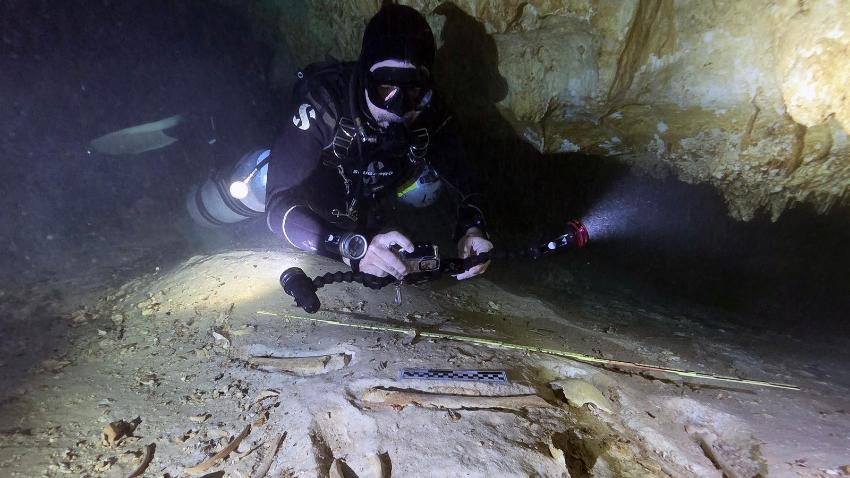
The find was made in a submerged cave near the popular tourist destinations of Tulum and Playa del Carmen, an area known for its extensive network of cenotes and underwater caverns. Researchers believe the remains could provide valuable information about prehistoric migration patterns, burial practices, and the adaptation of early human communities to changing landscapes.
Credit: Eugenio Acevez / National Institute of Anthropology and History (INAH) via Associated Press (AP)
A Window Into the Distant Past
Today, the cave where the remains were found is completely flooded. However, thousands of years ago, during the final stages of the last Ice Age, sea levels were much lower than they are today. As a result, many of the cave systems that now lie underwater were once dry and accessible to humans and animals.
The skeleton was discovered approximately eight meters below the current water level and hundreds of meters from the cave entrance. This suggests that the individual entered the cave long before it became submerged by rising sea levels.
According to archaeologists, the location of the remains is one of the most intriguing aspects of the discovery. The position of the skeleton may indicate that the individual was intentionally buried inside the cave rather than having died there accidentally. Further scientific analysis will be required to confirm this theory.
Why the Discovery Matters
Ancient human remains from this period are relatively rare, making each discovery particularly valuable to researchers. The remains could help scientists better understand who the first inhabitants of the region were and how they adapted to dramatic climate and environmental changes at the end of the Ice Age.
The Yucatán Peninsula has become one of the most important regions in the world for studying early human history in the Americas. Several significant discoveries have been made in the area’s underwater cave systems over the past few decades, providing evidence that humans occupied the region thousands of years earlier than previously believed.
Experts hope that modern scientific techniques, including DNA analysis, isotopic studies, and advanced dating methods, will reveal additional details about the individual’s ancestry, diet, health, and lifestyle.
The Unique Environment of Yucatán’s Caves
The Yucatán Peninsula is famous for its cenotes—natural sinkholes formed when limestone bedrock collapses and exposes groundwater beneath the surface. These cenotes are connected by vast underground cave networks stretching for hundreds of kilometers.
Because of their stable temperatures, limited exposure to sunlight, and relatively undisturbed conditions, these caves often preserve organic materials exceptionally well. Human remains, animal bones, and even ancient artifacts can remain intact for thousands of years.
This unique preservation environment has transformed the region into an archaeological treasure trove. Researchers continue to discover evidence of extinct animals, prehistoric human activity, and environmental conditions dating back to the end of the Pleistocene era.

Credit: Eugenio Acevez / National Institute of Anthropology and History (INAH) via Associated Press (AP)
Rising Sea Levels and Ancient Landscapes
One of the reasons these discoveries are so important is that they help scientists reconstruct ancient landscapes. During the Ice Age, large amounts of the Earth’s water were trapped in glaciers and ice sheets, causing global sea levels to be significantly lower.
As the climate warmed and glaciers melted, sea levels gradually rose, flooding coastal areas and cave systems across the world. The Yucatán caves serve as natural time capsules, preserving evidence from a period when the region looked very different from today.
By studying the cave environment and the remains found within it, researchers can gain a better understanding of how prehistoric communities responded to environmental changes and shifting ecosystems.
Insights Into Early Human Migration
The origins of the first people to settle in the Americas remain one of archaeology’s most fascinating topics. Scientists believe that groups of hunter-gatherers migrated from Asia into North America during the late Ice Age, eventually spreading throughout the continent.
Discoveries like the one in Mexico provide critical clues about these early populations. Skeletal remains can reveal information about physical characteristics, genetic relationships, and migration routes that shaped the development of human societies across the Americas.
Each new discovery contributes another piece to a complex puzzle that researchers have been trying to solve for decades.

Credit: Eugenio Acevez / National Institute of Anthropology and History (INAH) via Associated Press (AP)
Future Research and Scientific Analysis
Although the remains are estimated to be at least 8,000 years old, further testing may determine a more precise age. Archaeologists will continue examining the skeleton and surrounding cave deposits to gather additional evidence about the individual’s life and death.
Future studies may also help determine whether the cave served as a burial site, shelter, ceremonial location, or simply a place visited by ancient inhabitants of the region.
As technology continues to advance, scientists are able to extract more information from ancient remains than ever before. This means that discoveries made today could provide answers to questions that were impossible to investigate just a few decades ago.
Conclusion
The discovery of 8,000-year-old human remains in an underwater cave in Mexico represents another significant milestone in the study of early human history. Hidden beneath the waters of the Yucatán Peninsula, these ancient remains offer a rare glimpse into a world that existed thousands of years before modern civilization.
As researchers continue their work, the findings may deepen our understanding of prehistoric life, ancient migrations, and the remarkable adaptability of early humans in a rapidly changing world.
This article is based on information released by Mexico’s National Institute of Anthropology and History (INAH), research conducted by archaeologists involved in the study of the submerged cave systems of the Yucatán Peninsula, and reports published by archaeological and scientific media covering the discovery of the 8,000-year-old human remains in an underwater cave near Mexico’s Caribbean coast
Written by Hidden Civilizations Editorial Team