On a remote island off the coast of British Columbia, Canada, archaeologists uncovered evidence of human activity dating back roughly 14,000 years—thousands of years before the Egyptian pyramids were built. The discovery offers a remarkable glimpse into the lives of some of the earliest known inhabitants of North America and provides fascinating support for Indigenous oral traditions passed down for generations.
Imagine standing on the Pacific coast more than 14,000 years ago.
The world would look almost unrecognizable. Massive glaciers covered large parts of North America, sea levels were different, and the climate was far colder than today.
Yet humans were already living along the remote Pacific coastline.
On Triquet Island, off the coast of British Columbia, archaeologists uncovered evidence of an ancient settlement that is helping scientists rethink how and when humans spread across North America.
A Fire That Burned 14,000 Years Ago
One of the most important discoveries at the site was an ancient hearth buried approximately 2.5 meters beneath layers of soil and peat.
Inside the fire pit, researchers found tiny fragments of charred material. Radiocarbon dating placed the remains at approximately 13,600–14,086 years ago.
The significance of that date is enormous.
The Great Pyramid of Giza was constructed roughly 4,500 years ago. That means the human activity recorded at Triquet Island is around three times older than the pyramids.
The people who built the ancient hearth lived in a world separated from ours by thousands of years of environmental and cultural change.
But their tools have left behind clues about how they survived.
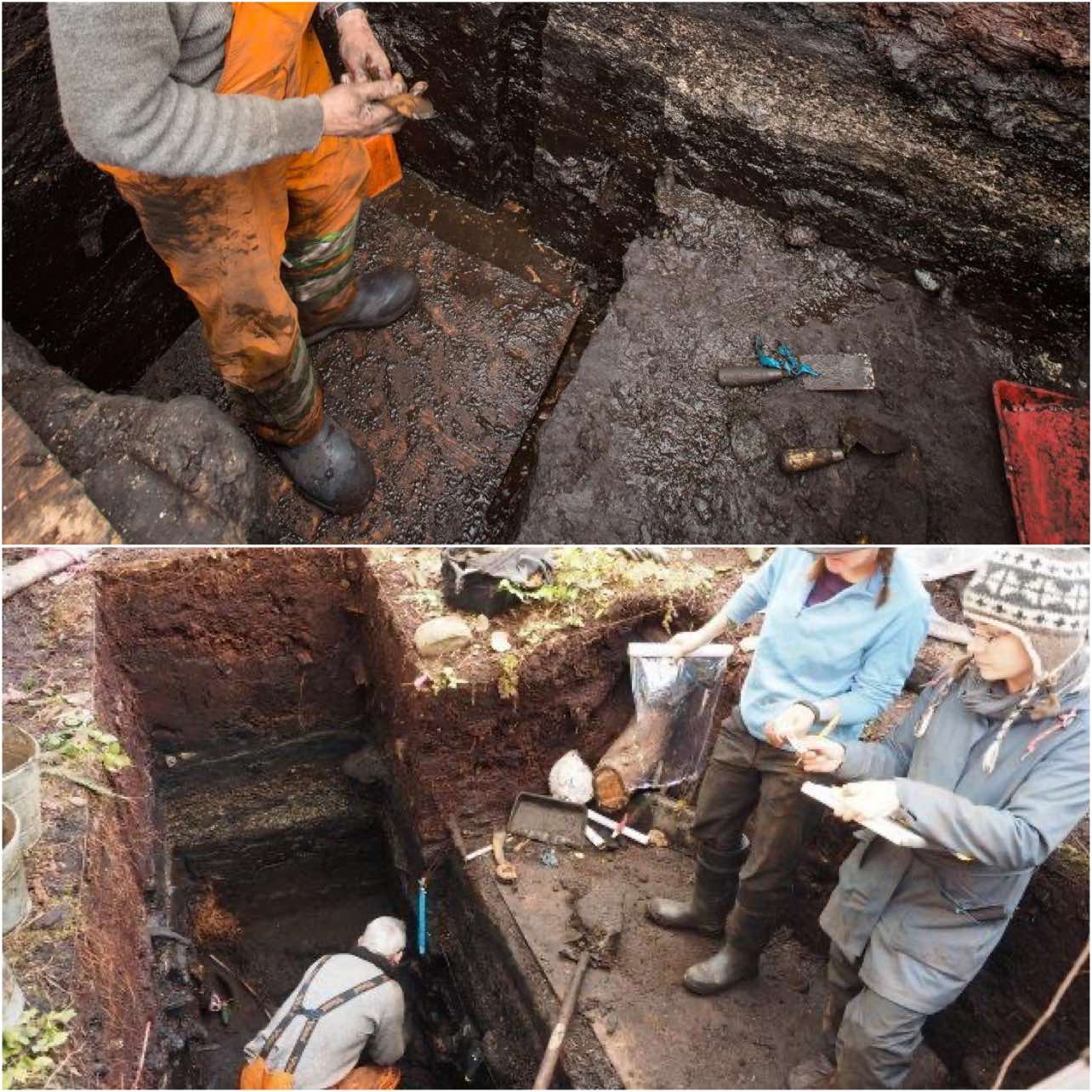
Photo credit: Grant Callegari / Hakai Institute.
Tools From an Ancient Coastal Community
Archaeologists uncovered a collection of artifacts that reveal a surprisingly sophisticated way of life.
Among the discoveries were:
• Bone fishing hooks and projectile points
• A wooden hand drill, likely used for making fire
• An atlatl, a device used to launch spears or darts with greater force and distance
• Sharp obsidian tools
The obsidian is particularly fascinating.
The volcanic glass appears to have originated more than 200 kilometers away, suggesting that these ancient people were not living in complete isolation.
The material had either been transported by the people themselves or obtained through exchanges with other groups.
Either possibility points to something important: ancient coastal communities were mobile and connected across surprisingly large distances.
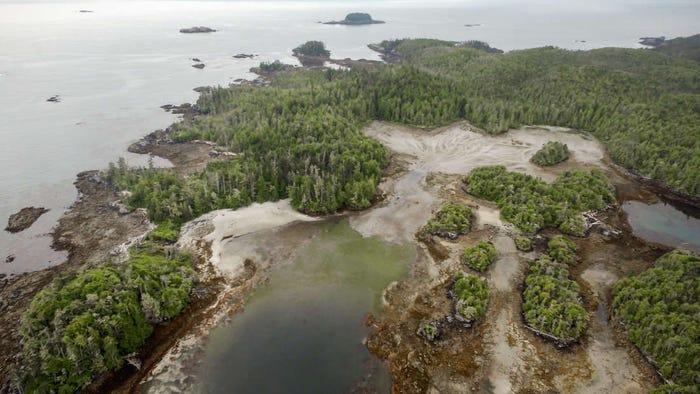
Photo credit: Keith Holmes / Hakai Institute. Science Friday and The World specifically credit Keith Holmes/Hakai Institute for an image of Triquet Island.
A Story Preserved for Generations
Perhaps the most remarkable aspect of the discovery is its connection to the traditional knowledge of the Haíɫzaqv (Heiltsuk) Nation.
For generations, Heiltsuk communities have preserved oral traditions known as núyṃ, describing an ancient coastal landscape that remained free of ice during the last Ice Age.
According to these traditions, such places provided refuge for their ancestors while much of the surrounding region was affected by glaciation.
The archaeological evidence from Triquet Island provides an extraordinary point of connection between those traditions and the physical record preserved beneath the ground.
The site demonstrates why Indigenous knowledge can be an important part of understanding the ancient past. Oral traditions can preserve memories and knowledge about landscapes, places, movements and events across many generations.
In this case, archaeology provides physical evidence that people were indeed living in this coastal region during an extremely ancient period.
Challenging the Traditional Story of the First Americans
For much of the 20th century, one of the dominant explanations for the arrival of humans in the Americas focused on an inland route.
According to the traditional Ice-Free Corridor model, people migrated from Siberia into Alaska through Beringia and eventually moved south through an ice-free passage between massive ice sheets.
But archaeological discoveries have increasingly complicated that picture.
One alternative explanation is known as the “Kelp Highway” hypothesis.
The idea is that some of the earliest people may have traveled southward along the Pacific coastline, using boats and relying heavily on the abundant marine resources found along the shore.
Fish, shellfish, sea mammals, birds, kelp forests and coastal plants could have provided a rich source of food.
A chain of islands and sheltered coastal areas may also have offered natural stopping points for migrating communities.
Triquet Island fits remarkably well into this broader picture.
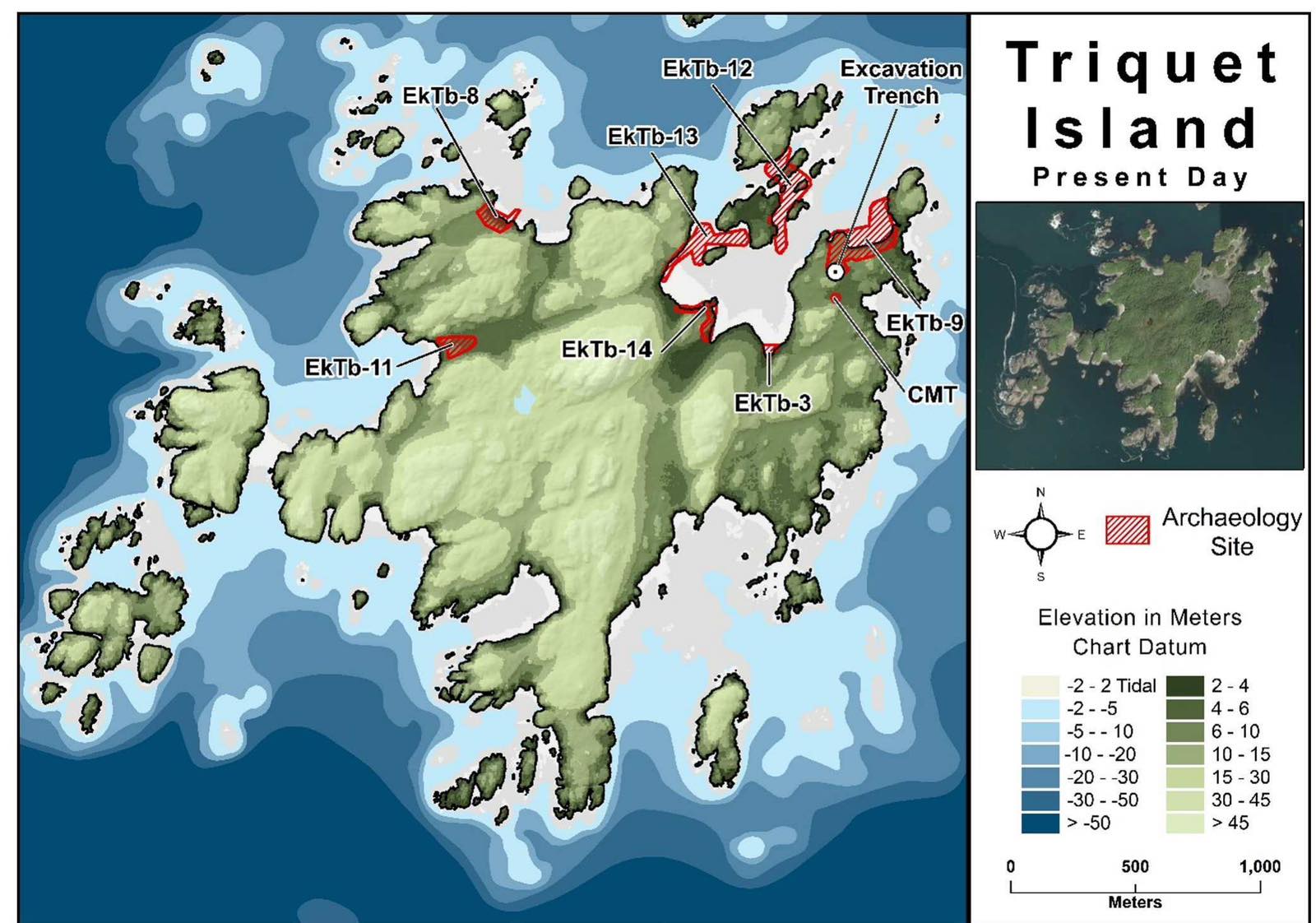
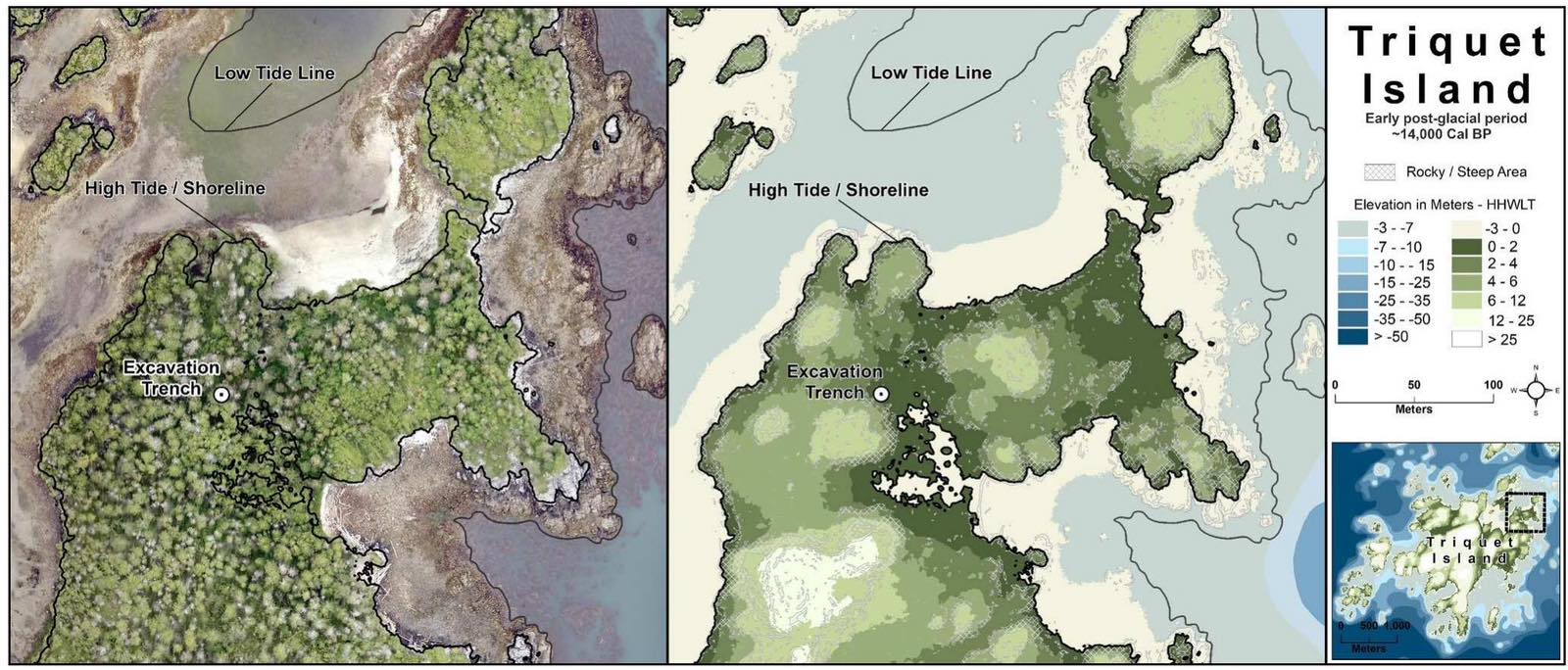
Credit: K. Holmes / Hakai Institute
People Were Already Moving Along the Pacific Coast
The discovery does not necessarily prove that every early population entered the Americas by boat.
But it provides important evidence that humans were living along the Pacific coast at a very early date.
That matters because some versions of the Ice-Free Corridor model suggest that the interior route became viable only later.
If people were already established along the Pacific coast thousands of years earlier, then the coastal migration hypothesis becomes increasingly important in explaining the peopling of the Americas.
The Pacific coastline may have functioned as an ancient migration highway.
Instead of imagining the first Americans simply walking south through the center of the continent, researchers now have to consider a much more complex story—one involving coastal travel, boats, islands, fishing, hunting and long-distance movement.
A Landscape Very Different From the One We See Today
There is another fascinating detail to remember.
The coastline around Triquet Island looked very different 14,000 years ago.
During the end of the last Ice Age, global sea levels were significantly lower than today. Glaciers were still shaping the landscape, and coastlines were constantly changing.
Some ancient settlements may now lie beneath the sea.
This creates a major challenge for archaeologists searching for the earliest coastal communities.
The evidence they are looking for may not always be on land. Some of it could be underwater, hidden beneath thousands of years of changing shorelines and rising sea levels.
That means the archaeological record we have today may represent only a fraction of the communities that once lived along the ancient Pacific coast.
More Than an Archaeological Site
Triquet Island is important for more than its age.
The site gives researchers clues about how people lived, traveled, hunted, fished and interacted with other communities during one of the most dramatic periods in Earth’s recent history.
It also highlights the importance of combining different kinds of knowledge.
Archaeology provides physical evidence: charcoal, tools, bones and other remains.
Indigenous oral traditions preserve knowledge transmitted through generations.
Together, these sources can help reconstruct a past that would otherwise be almost impossible to see.
A Window Into the Deep Past
The people who lived on Triquet Island did not leave behind monumental buildings or written records.
They left something much smaller:
A fire.
A few tools.
Fragments of bone.
Pieces of volcanic glass.
Yet thousands of years later, these seemingly ordinary objects have become extraordinary evidence of human resilience.
They tell us that people were able to survive and establish communities along the Pacific coast during the closing stages of the last Ice Age.
They also remind us that the story of human migration into the Americas is far more complicated—and far more fascinating—than once believed.
Older Than the Pyramids
When the first stones of the Egyptian pyramids were eventually placed thousands of years later, the people of Triquet Island had already been gone for millennia.
Their settlement belonged to a world almost unimaginable to us today.
But beneath layers of soil and peat, their ancient fire remained.
And when archaeologists uncovered it, a story that had been silent for thousands of years began to speak again.
Triquet Island is not simply a place where ancient artifacts were found. It is a window into a time when humans were exploring a changing continent, following coastlines, crossing waterways and building lives at the edge of an Ice Age world.
And perhaps most remarkably, part of that story had already been preserved—not in stone or written documents, but in the living oral traditions of the people whose ancestors were there.
Written by Hidden Civilizations Editorial Team