
Archaeologists working in central Mexico have uncovered a remarkable collection of ancient tombs dating back more than 1,500 years, shedding new light on the people who lived under the influence of the powerful Teotihuacan civilization. The discovery, made during archaeological surveys conducted ahead of a major railway construction project, is being hailed as an important contribution to the understanding of ancient Mesoamerican cultures.
Among the most significant findings is a tomb containing the remains of eight individuals accompanied by 47 miniature ceramic vessels, a rare concentration of ritual objects that experts believe were used in funerary ceremonies. The discovery offers valuable insight into the burial customs, spiritual beliefs, and social practices of communities that flourished during the height of Teotihuacan’s influence.
The excavation site is located in central Mexico, an area that played an important role in the broader cultural network connected to Teotihuacan. At its peak between the third and sixth centuries CE, Teotihuacan was one of the largest cities in the world, home to tens of thousands of people and known for its impressive pyramids, planned urban layout, and extensive trade connections.
Researchers identified a total of five tombs and several additional burials at the site. The most notable tomb appears to have been used repeatedly over an extended period, suggesting it may have served as a family burial chamber or a communal resting place for members of the same group. Evidence indicates that older remains were sometimes moved to make room for new burials, reflecting a continuing connection between the living and their ancestors.
The 47 miniature vessels found inside the tomb have attracted particular attention from archaeologists. While small in size, such objects often carried deep symbolic meaning. Experts believe they may have contained food, water, beverages, or ceremonial offerings intended to accompany the deceased into the afterlife. Similar practices have been documented in various ancient civilizations, where grave goods were believed to provide comfort, protection, or sustenance after death.
In addition to the ceramic vessels, archaeologists recovered shell ornaments and decorative objects crafted from marine materials. These items are especially significant because they indicate the existence of long-distance trade networks. Since the excavation site is located far from the coast, the presence of marine shells suggests that communities in the region maintained connections with distant areas, exchanging goods, materials, and possibly cultural traditions.
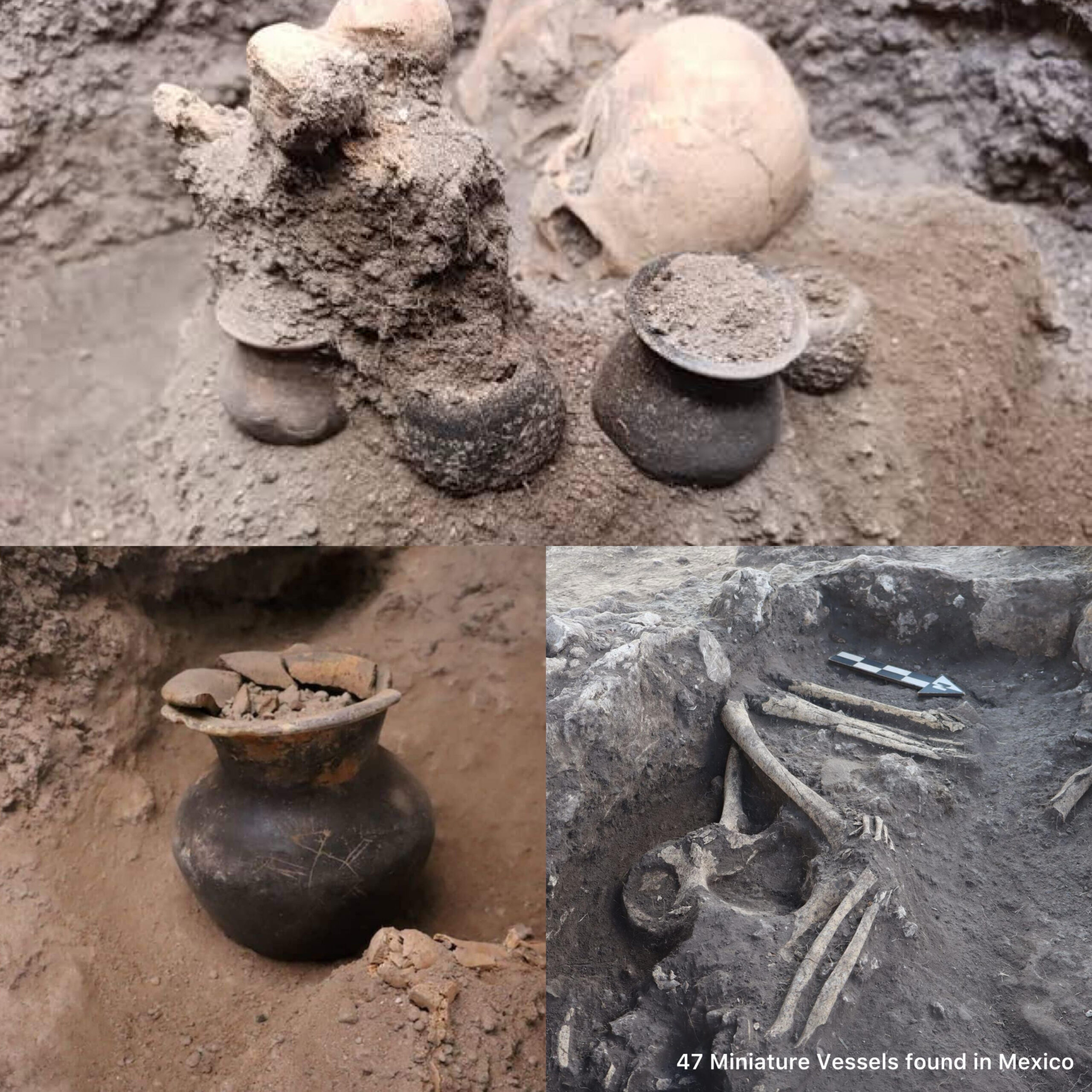
Credit: Víctor Heredia / INAH (Instituto Nacional de Antropología e Historia)
Another intriguing aspect of the discovery is the positioning of some of the individuals. Several were buried in seated positions, a practice known from other Mesoamerican cultures and often associated with specific religious or social customs. Researchers hope that further analysis will reveal whether the people buried in this manner held special status within their community. The posture may have been intended to reflect the deceased’s role within society or their perceived journey into the afterlife.
The human remains themselves could provide a wealth of information. Modern scientific techniques allow researchers to study bones and teeth in order to learn about an individual’s age, health, diet, and even geographic origins. Such analyses may help archaeologists reconstruct daily life in the region and better understand the population that lived there centuries before the arrival of Europeans.
The discovery also highlights the importance of archaeological rescue projects conducted before major infrastructure developments. Many of the world’s most important archaeological finds have been made during construction work, where careful excavation allows researchers to document and preserve historical evidence that might otherwise be lost forever.
According to specialists, the newly discovered tombs represent only a small part of what may still lie hidden beneath the region. Further excavations could uncover additional structures, artifacts, and burial sites, helping to paint a more complete picture of life during the Teotihuacan era.
What we know about Teotihuacan?
Although Teotihuacan remains one of the most studied ancient cities in the Americas, many questions about its people, beliefs, and influence remain unanswered. Discoveries such as these provide valuable clues that help bridge gaps in the historical record and deepen our understanding of one of the continent’s most fascinating civilizations. One of the most fascinating facts about this ancient city is that no one knows for certain who built it.
As investigations continue, archaeologists hope the site will reveal even more information about the traditions, rituals, and social organization of the communities that once thrived under Teotihuacan’s cultural influence. Each artifact and burial adds another piece to the puzzle, bringing modern researchers one step closer to understanding a world that disappeared more than a millennium ago but continues to captivate scholars and history enthusiasts alike.
This article is based on information released by Mexico’s National Institute of Anthropology and History (INAH) and reports published by archaeological news outlets covering the discovery of Teotihuacan-era tombs and 47 miniature vessels in Tula, Hidalgo, Mexico.
Written by Hidden Civilizations Editorial Team

One Comment
That’s incredible! It’s amazing to think about the craftsmanship involved in creating so many small vessels for burial sites.