A routine archaeological excavation in the German city of Paderborn has led to one of the most fascinating discoveries of recent years. While preparing the site for the construction of a new administrative building, archaeologists uncovered an exceptionally well-preserved wax tablet notebook dating back around 700 years.
The remarkable artifact was found inside a medieval latrine, along with fragments of silk, pottery, wooden objects, woven baskets, knives, and other everyday items that provide historians with an extraordinary glimpse into life during the 13th and 14th centuries.
An Unexpected Discovery Beneath a Construction Site
The excavation took place near the former Abdinghof Monastery, one of Paderborn’s most historically significant locations.
As is common practice in Germany, archaeologists were asked to investigate the area before construction work began to ensure that any historical remains could be properly documented and preserved.
Few expected that one of the excavation’s most valuable discoveries would come from what was once a medieval toilet.
Why Archaeologists Study Ancient Latrines
Although they may seem like unusual places to search for history, medieval latrines are among the richest archaeological sites.
Why? For centuries, people discarded broken household items, worn clothing, food waste, wooden tools, pottery, and occasionally valuable personal belongings into these pits.
Because the environment inside a waterlogged latrine contains very little oxygen, organic materials such as wood, leather, textiles, and even writing surfaces can survive for hundreds of years.
Without these unique preservation conditions, the notebook would almost certainly have disappeared long ago.

Credit: LWL / Sveva Gai
A Medieval Notebook Unlike Modern Books
Unlike modern notebooks made from paper, this medieval example consists of ten wooden tablets coated with a thin layer of wax.
Instead of writing with ink, the owner used a metal or bone stylus to scratch letters into the wax surface.
Once the information was no longer needed, the wax could simply be smoothed over and reused, making wax tablets practical, reusable writing tools.
The notebook is protected by an embossed leather cover decorated with elegant patterns, suggesting it belonged to someone of relatively high social standing.
Who Might Have Owned It?
Although researchers have not identified the notebook’s owner, several clues point toward an educated individual.
The surviving text is written in Latin, the language commonly used in medieval administration, education, commerce, and the Church.
Archaeologists believe the notebook may have belonged to a merchant, clerk, administrator, or another literate professional who regularly recorded business transactions, reminders, or financial accounts.
Future research may even reveal the owner’s identity through historical records connected to nearby properties.
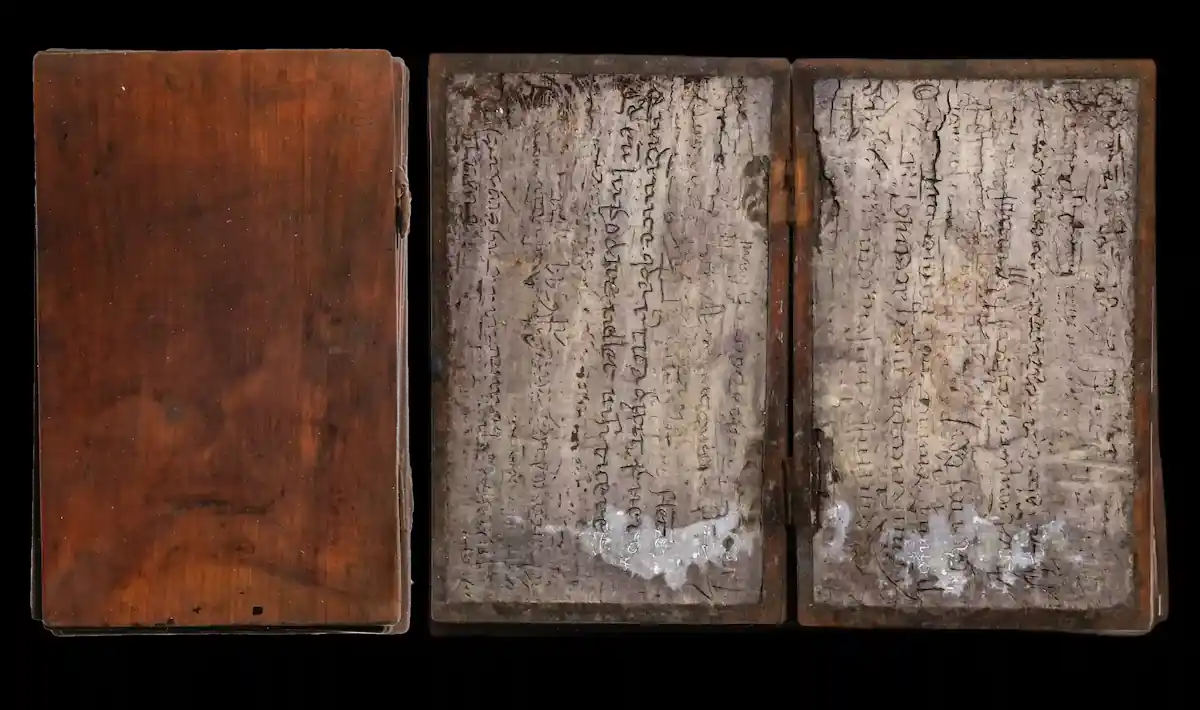
Credit: LWL / S. Brentführer
Scientists Are Carefully Reading the Text
Even if its hard, some letters can already be recognized, most of the text is still being analyzed.
The notebook’s greatest value lies in the writing preserved on its wax-covered pages.
Conservators are using advanced imaging techniques to recover as much of the original text as possible without damaging the fragile surface.
Because wax tablets were often reused, experts believe older writing may still exist beneath later notes, potentially revealing multiple layers of information recorded over several years.
If successfully decoded, the notebook could offer rare insights into commerce, literacy, administration, and everyday life in medieval Germany.
Silk Fragments Tell Another Story
Among the excavation’s most unusual finds were several small pieces of finely woven silk.
Researchers believe the fabric was originally part of expensive clothing before being cut into smaller pieces and reused.
Although additional scientific analysis is still underway, the discovery highlights the medieval practice of repairing and recycling valuable materials rather than discarding them.
Since silk was considered a luxury imported from distant trade routes, its presence also suggests that wealthy residents once lived in the area.
More Than Just One Extraordinary Artifact
The excavation produced dozens of additional finds, including:
• Wooden buckets
• Pottery vessels
• Knives
• Leather goods
• Woven baskets
• Textile fragments
• Animal bones
• Seeds and food remains
Together, these objects provide archaeologists with a detailed picture of daily urban life nearly seven centuries ago.
Rather than focusing solely on kings and nobles, discoveries like these help historians understand the routines of ordinary people.
Why This Discovery Matters
The notebook is far more than an unusual object recovered from an unexpected place.
Personal notes are much rarer than official medieval documents preserved in churches or government archives. They have the potential to reveal how people managed businesses, kept financial records, communicated with others, and organized everyday activities.
Combined with the other artifacts recovered from the site, the notebook represents an invaluable historical resource that may continue to provide new information for years to come.
A Remarkable Window into Medieval Life
The discovery reminds us that some of history’s most important archaeological finds come from the most unexpected locations.
What was once an ordinary medieval latrine has become a unique time capsule, preserving objects that would normally have disappeared centuries ago.
As conservation and research continue, archaeologists hope the notebook and the surrounding artifacts will deepen our understanding of literacy, trade, daily life, and urban society in medieval Germany, offering future generations an even clearer picture of a world that existed more than 700 years ago.
This article is based on official information released by the Regional Association of Westphalia-Lippe (LWL) and research conducted by archaeologists involved in the excavation of medieval latrines in Paderborn, Germany, along with reports published by archaeological and scientific media covering the discovery of the 700–800-year-old wax notebook preserved in a medieval toilet alongside fragments of fine silk believed to have been used as wiping material. The findings provide rare insights into medieval literacy, social status, daily life, and hygiene practices.
Written by Hidden Civilizations Editorial Team