More than 5,800 years ago, long before the first cities appeared and thousands of years before the Romans built their famous roads across Britain, Neolithic people were already solving one of the most difficult problems of everyday life: how to cross a wet and dangerous landscape without sinking into the mud.
Their solution was remarkably sophisticated.
They built a wooden walkway across a vast prehistoric wetland in what is now Somerset, England.
Today, it is known as the Sweet Track, and it is considered one of the oldest known engineered trackways in Northern Europe.
What makes the discovery extraordinary is not simply its age.
The Sweet Track provides archaeologists with an unusually detailed glimpse into the lives of Britain’s early farming communities — people who lived nearly 6,000 years ago, cultivated crops, raised animals, worked wood and stone, traded across surprisingly long distances, and were capable of organizing the construction of substantial wooden structures. Even more remarkably, the wetland that once threatened to swallow the trackway ultimately helped preserve it.
A Road Through a World of Water
Imagine the landscape of Somerset around 3800 BC. There were no paved roads, bridges or modern drainage systems. Instead, much of the region consisted of wetlands, marshes, shallow lakes and areas of waterlogged peat. For the Neolithic communities living in the area, these wetlands were not simply obstacles. They were part of their world. People moved through them, collected resources and hunted, fished and gathered materials. Settlements were often located on slightly higher or drier ground, while the surrounding wetlands could make travel extremely difficult.
At some point during the early Neolithic period, people decided to create a permanent route across the marsh.
The result was the Sweet Track.
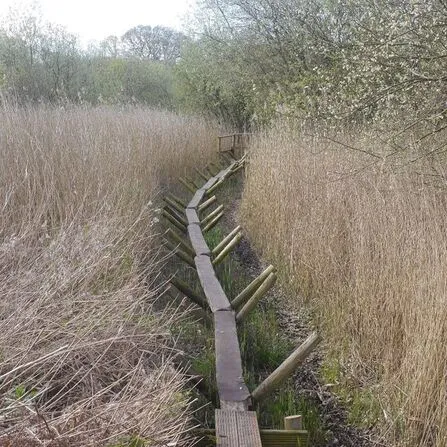
The structure connected an island settlement in the area of Westhay with higher ground toward Shapwick, crossing nearly two kilometres of difficult wetland terrain.
For the people who built it, this was not merely a path.
It was an important piece of infrastructure.
A Neolithic Engineering Project
The Sweet Track may look simple compared with a modern bridge or road, but its construction required careful planning. The builders worked with timber, peat and the natural conditions of the wetland. They created a raised walkway using wooden supports driven into the soft ground. Crossed wooden pegs formed structures resembling an X, creating supports for horizontal planks. Heavy split timber boards were then positioned across these supports to form the walking surface. The result was an elevated wooden path above the wet and unstable ground. The engineering principle was straightforward:
Keep people’s feet above the water and distribute the weight of the walkway across the soft peat.
But achieving that over a distance approaching two kilometres was a considerable undertaking for a Neolithic community. Large quantities of timber had to be selected, cut and transported. The wood had to be prepared and positioned carefully. The route itself also had to be planned.
This tells archaeologists something important about the society that built it.
The Sweet Track was not the product of a single individual casually placing a few boards across a puddle.
It required cooperation, planning and knowledge of the landscape.
The Date Hidden Inside the Wood
One of the most remarkable aspects of the Sweet Track is that archaeologists were able to determine when some of the timber was cut with extraordinary precision.
The answer came from dendrochronology, commonly known as tree-ring dating.
Trees record their growth year by year. Variations in the width of tree rings can reflect environmental conditions, allowing scientists to compare patterns between different pieces of ancient timber.
The analysis of the Sweet Track timbers indicated that the trees used for its construction were felled during the winter or early spring of 3807 BC or 3806 BC.
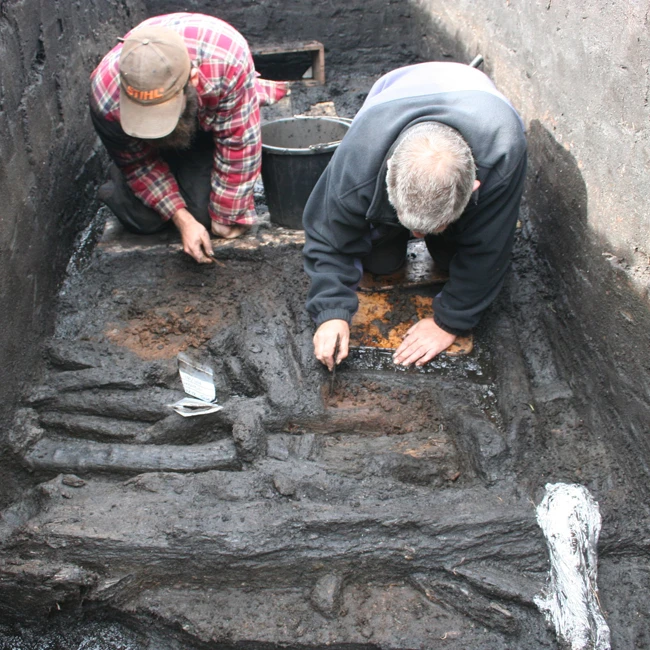
That means the trackway can be placed within a remarkably precise historical window.
We are therefore not simply looking at an “approximately 6,000-year-old road.”
We have evidence for a construction event taking place more than five and a half millennia ago.
The builders of the Sweet Track were working at a time when farming communities were becoming established across Britain and other parts of Europe.
Who Built the Sweet Track?
The people responsible were Neolithic communities — early farmers whose lives were dramatically different from those of later societies.
They had no metal tools.
They had no machinery.
They had no written language.
Yet they were capable of manipulating timber on a large scale and creating carefully engineered structures.
Their tools were primarily made from materials such as stone, wood and bone.
The forests around them provided enormous quantities of timber, while the wetlands supplied other resources.
The construction of the Sweet Track demonstrates how well these communities understood the properties of wood and the behavior of wetland environments.
They knew which areas were stable enough to support structures and how to create a raised surface across the marsh.
The Wetland That Preserved the Past
Ironically, the same environment that made the Sweet Track necessary eventually helped preserve it. The Somerset Levels contain extensive areas of peat. Peat forms when plant material accumulates in waterlogged environments where there is very little oxygen. Under these conditions, organic materials that would normally decay relatively quickly can survive for thousands of years.
Wood, plant remains and other organic objects can become trapped in the peat.
As a result, archaeologists studying the Sweet Track were able to recover objects that would rarely survive at ordinary archaeological sites.
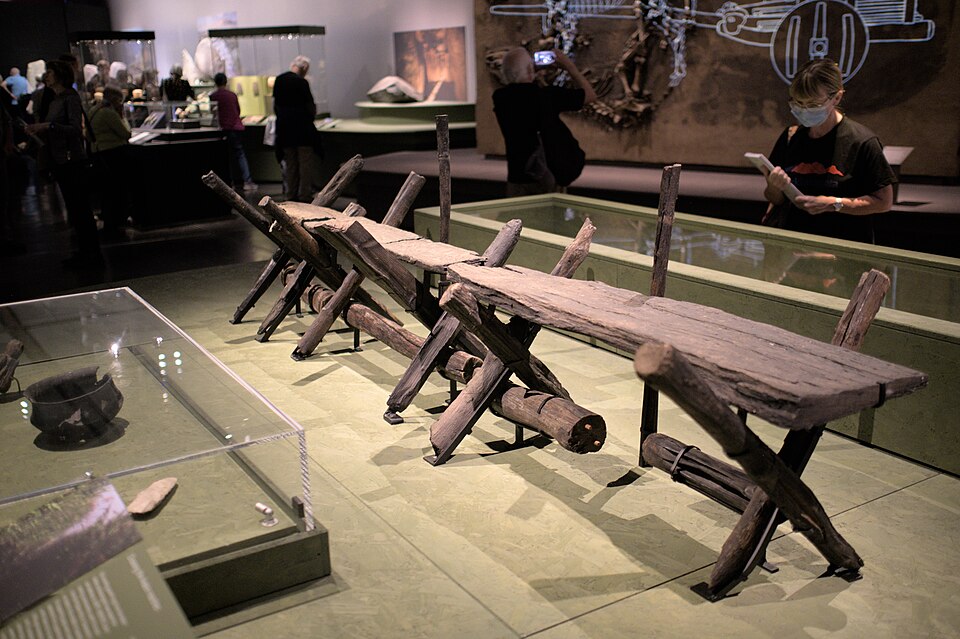
Instead of finding only fragments of stone and pottery, researchers encountered preserved pieces of Neolithic wood and other organic materials.
The wetland effectively became a time capsule.
A Road Full of Lost Objects
One of the most fascinating aspects of the Sweet Track is that it was not empty when archaeologists discovered it.
People had walked across it for centuries, and as they travelled, objects were occasionally dropped or left behind.
Those accidental losses provide an intimate glimpse into everyday life.
Among the finds were hazelnut shells, pottery, wooden objects and components associated with bows.
These objects may seem ordinary, but archaeologically they are extremely valuable.
A broken or discarded object can tell researchers what people were eating, what tools they used, what materials they worked with and how they moved through the landscape.
In a sense, the Sweet Track became an ancient archaeological “snapshot.”
It captured fragments of ordinary life rather than only ceremonial or monumental objects.
The Mysterious Jadeite Axe
Perhaps one of the most extraordinary objects associated with the wider Sweet Track discoveries is a highly polished jadeite axehead.
Jadeite is not naturally available in Somerset.
The stone has been traced to the Italian Alps, thousands of kilometres away.
Its presence in Neolithic Britain is evidence of surprisingly extensive exchange networks.
Think about what that means.
A stone axe made from material originating in the Alps somehow travelled across prehistoric Europe and eventually reached Britain.
There were no roads in the modern sense.
There were no trains, ships powered by engines or trucks.
Yet objects and materials were moving across enormous distances.
The jadeite axe therefore tells a much bigger story than simply the story of one tool.
It provides evidence that Neolithic communities were connected through networks of exchange that stretched far beyond their immediate surroundings.
More Than a Tool
The polished jadeite axe also raises questions about why people valued particular objects. A stone axe was certainly useful. It could be used for woodworking and other practical tasks. But highly polished axes made from rare stone may also have carried social or symbolic significance. Their unusual material and craftsmanship could have made them valuable possessions. Some may have been exchanged between communities, displayed, deposited in special places or passed between generations. Archaeologists continue to debate the exact social meaning of such objects.
But their presence demonstrates that Neolithic society was more interconnected and complex than the stereotype of isolated prehistoric farmers might suggest.
Why Build the Track?
The exact purpose of the Sweet Track is another fascinating question.
The walkway connected areas of settlement and higher ground across a difficult wetland environment.
It would have made movement significantly easier and safer.
People could transport food, tools, timber and other materials without having to struggle through deep mud or shallow water.
The track may also have provided access to resources located on different parts of the landscape.
For a farming community, reliable movement would have been extremely important.
Animals, crops, tools, firewood and other resources all needed to be transported.
A carefully constructed walkway could transform a dangerous marsh from an obstacle into a usable part of the landscape.
A Landscape Being Reshaped by Humans
The Sweet Track is also important because it shows that Neolithic people were not simply adapting to nature.
They were actively reshaping their environment.
They selected trees.
They cut timber.
They constructed supports.
They laid boards.
They created a route where none had previously existed.
This is a small-scale example of something that would become increasingly important throughout human history: the transformation of natural landscapes to make them easier to inhabit and travel through.
Thousands of years later, civilizations would build enormous roads, canals, bridges and cities.
But the principle was already present here.
A community encountered an environmental challenge and engineered a solution.
How the Sweet Track Was Discovered
The discovery itself happened much more recently.
In 1970, a local peat worker named Ray Sweet was clearing a drainage ditch in the Somerset Levels when he encountered pieces of ancient timber.
What initially appeared to be ordinary wood turned out to be something much more significant.
Archaeologists investigated the remains and realized that they were looking at a prehistoric wooden trackway.
The discovery eventually became associated with the name of the person who found it.
Thus, the ancient road became known as the Sweet Track.
What Ray Sweet uncovered would go on to become one of the most important archaeological discoveries for understanding Neolithic Britain.
A Road Older Than Stonehenge
The age of the Sweet Track becomes even more impressive when placed on a broader timeline. Its construction around 3800 BC predates many of Britain’s most famous prehistoric monuments. Stonehenge, for example, was developed over many stages beginning several centuries later. The pyramids of Giza would not be constructed until roughly 2,500 years after the Sweet Track. The Roman Empire was still thousands of years in the future. Written history in Britain was still unimaginably distant. The Sweet Track therefore belongs to a world that existed long before written records could tell us what people were doing.
Archaeology is the only way we can recover its story.
A Window Into Ordinary Neolithic Life
Perhaps the most valuable thing about the Sweet Track is that it does not represent the palace of a king or the tomb of a powerful ruler.
It represents something much more ordinary.
A road.
A walkway.
A piece of infrastructure created to make daily life easier.
And that makes it particularly valuable.
The archaeological record often preserves spectacular monuments, weapons and elite burials.
But ordinary structures can tell us how people actually lived.
The Sweet Track tells us that Neolithic communities needed reliable routes through their landscape.
They organized labor.
They understood materials.
They transported resources.
They exchanged goods across enormous distances.
And they invested time and effort into improving their environment.
What Happened to the Track?
The Sweet Track was eventually abandoned. Changes in the local environment, particularly rising water levels, caused the wetland landscape to change. The wooden structure became submerged and was gradually buried beneath layers of peat. For thousands of years, the ancient walkway disappeared from the visible landscape. The people who built it vanished. Their settlements changed. Their descendants lived through countless generations. Civilizations rose and fell elsewhere. But beneath the peat, the wooden timbers remained. The oxygen-poor environment slowed the natural processes that would normally destroy them.
And that is why archaeologists in the modern era were able to recover pieces of a road built more than 5,800 years ago.
A Message From 3800 BC
Standing beside a modern road today, it is easy to think of infrastructure as something that belongs to advanced societies.
Highways, bridges and railways depend on sophisticated technology.
But the Sweet Track reminds us that engineering is much older than modern civilization.
More than five and a half thousand years ago, people without metal tools, engines or modern mathematics were already designing structures according to the physical properties of their environment.
They understood that timber could be used as a structural material. They understood that soft ground required support. They understood that raising a walkway above water made travel possible.
And they had the organization necessary to turn those ideas into reality. The Sweet Track was eventually swallowed by the landscape. But the landscape also preserved it.
Today, its timbers offer archaeologists something incredibly rare: a direct connection to an ordinary day in Neolithic Britain.
A person walking across the wooden boards.
A tool slipping from someone’s hand.
A handful of hazelnut shells left behind.
A piece of pottery breaking.
A precious stone axe travelling thousands of kilometres from the Alps.
These tiny traces may seem insignificant individually.
Together, they tell the story of a society that was already changing the world around it.
The Sweet Track was more than an ancient road.
It was evidence of planning, craftsmanship, cooperation, trade and adaptation — all preserved beneath the peat for thousands of years.
And perhaps the most remarkable part is that its builders could never have imagined that one day, long after their wooden walkway disappeared beneath the water, archaeologists would uncover it and use its remains to reconstruct a small part of their lost world.
More than 5,800 years later, the road is gone.
Written by Hidden Civilizations Editorial Team