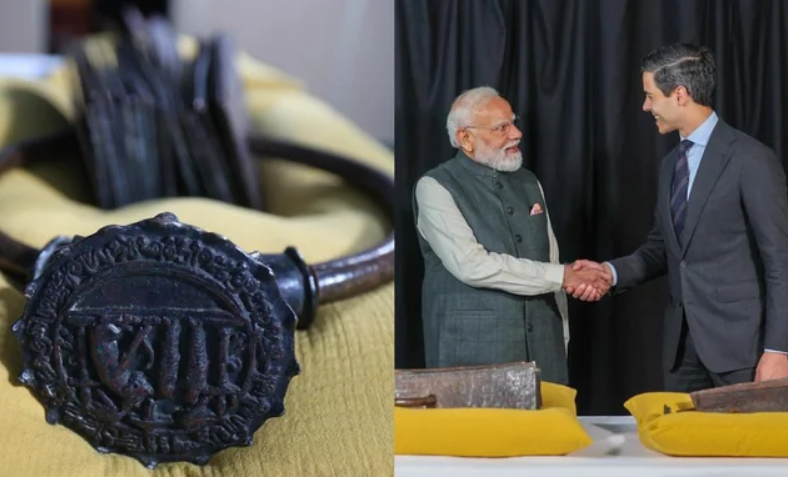
The artifacts, which are widely referred to in Europe as the ‘Leiden Plates’, are among the most historically valuable surviving records of the Chola kingdom. India has been pursuing their return since 2012.
In a significant move for cultural restitution, the Netherlands formally returned a set of 11th-century bronze plates from the Chola era to India on Saturday during Prime Minister Narendra Modi’s visit to the European country.
The transfer marked the culmination of years of diplomatic efforts by New Delhi and was presented as a symbol of deepening ties between the two nations.
The artifacts, widely known in Europe as the ‘Leiden plates,’ are among the most historically valuable preserved records of the Chola Empire.
Prime Minister Modi arrived in the Netherlands on Friday after halting in the UAE as part of his ongoing five-country tour, which also includes Sweden, Norway, and Italy.
PM Modi, in a post on X, announced that the Chola copper plates will be returned to India.
“A joyous moment for every Indian! The Chola copper plates, dating from the 11th century, will be returned to India from the Netherlands. I participated in the ceremony for the same in the presence of Prime Minister Rob Jetten,” he wrote.
The copper plates date back to the time of ruler Emperor Rajaraja Chola I, who reigned between 985 and 1014. Historians consider them one of the most significant works of Tamil heritage preserved outside of India.
The collection consists of 21 copper plates weighing around 30 kilograms. They are connected by a bronze ring that bears the royal seal of the Chola. Part of the inscriptions is written in Sanskrit, while the other part is in Tamil.
The records document grants awarded to a Buddhist monastery in Nagapattinam, highlighting the religious and cultural exchanges that flourished during the Chola period. Scholars say that the inscriptions offer valuable insight into maritime trade links between South India and Southeast Asia, as well as into the tradition of coexistence through religious communities at that time.
Historical records suggest that Rajaraja Chola I initially gave the order orally, which was previously recorded on palm leaves. His son, Rajendra Chola I, later engraved the details on copper plates to preserve them permanently. The binding button bears the emblem of Rajendra Chola.
The tiles were taken to the Netherlands in the 18th century by Florentius Kamper, who was associated with a Christian mission in India during the period when Nagapattinam was under Dutch control.
For decades, the artifacts remained stored in secured facilities in the Netherlands and were mainly accessible to academics and researchers upon request. Over time, they became well-known among historians and Tamil epigraphists, and also gained wider public recognition through mentions in “Ponniyin Selvan,” the iconic Tamil historical novel centered around the Chola Empire.
India’s restitution case received support at the 24th session of the Intergovernmental Commission for Return and Restitution, which recognized India as the true country of origin and encouraged dialogue between the two governments regarding their return.
The Netherlands ultimately decided to hand over the copper plates during Prime Minister Modi’s official visit, adding a cultural dimension to the growing partnership between India and the Netherlands.