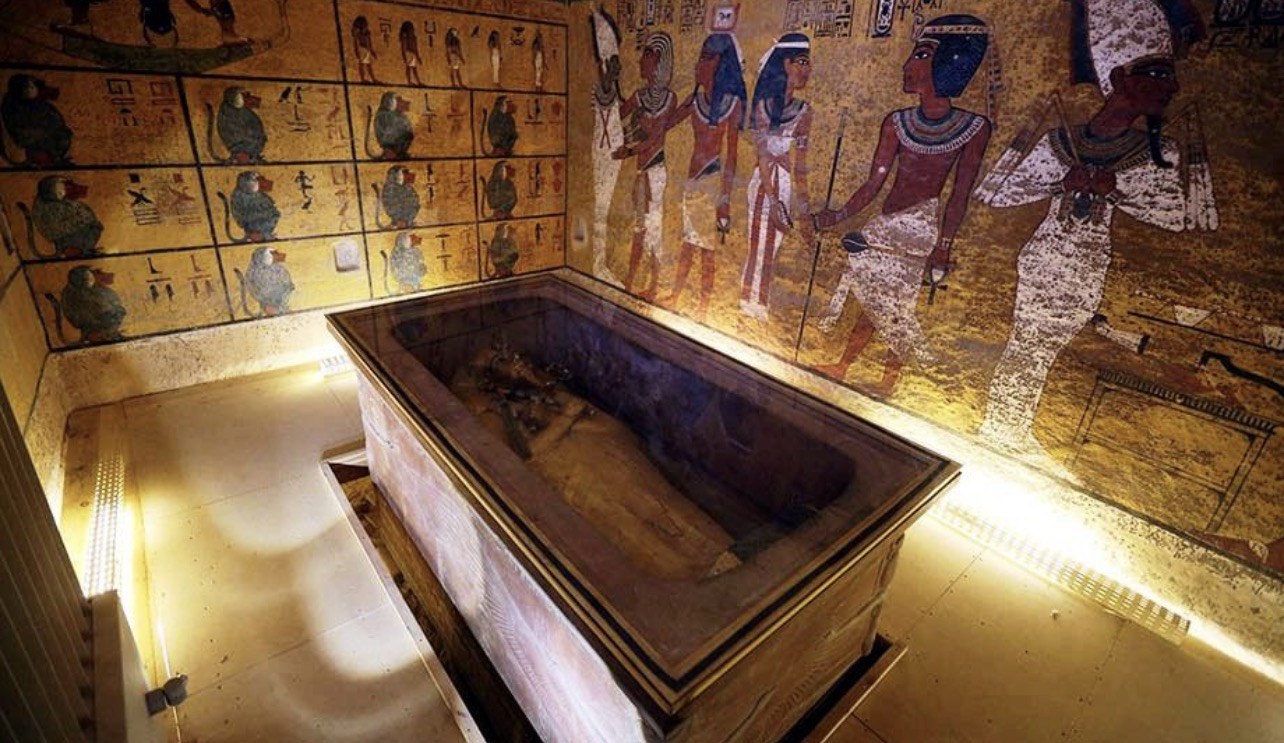
For more than a century, the tomb of Tutankhamun has remained one of the most fascinating archaeological discoveries ever made. Yet despite everything researchers have learned about the young pharaoh, one question continues to linger: was his tomb really built only for him?
New geophysical surveys around Tutankhamun’s famous tomb in Egypt’s Valley of the Kings have now detected several underground anomalies that may indicate the presence of previously unknown chambers or passageways.
The discovery is particularly intriguing because of an old theory suggesting that the tomb of Queen Nefertiti could be hidden somewhere beyond Tutankhamun’s burial chamber.
Researchers are not claiming that Nefertiti’s tomb has been found. But the latest results have given the idea new life.
A Tomb That Has Always Seemed Unusual
When British archaeologist Howard Carter entered Tutankhamun’s tomb in 1922, he uncovered one of the greatest archaeological discoveries of the modern era. The tomb, known as KV62, contained an extraordinary collection of objects, including gilded furniture, chariots, jewelry and the famous burial mask of the young pharaoh.
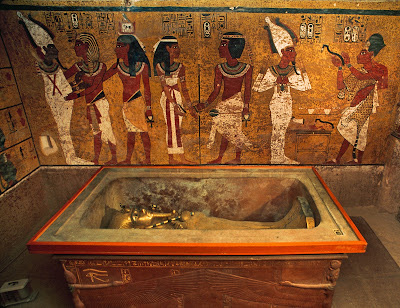
But there was something unusual about the tomb from the beginning.
It was surprisingly small compared with many other royal tombs in the Valley of the Kings.
Tutankhamun became pharaoh when he was only around nine years old and died roughly a decade later. One possibility is that his death came unexpectedly, leaving little time to construct a large royal tomb from scratch.
That has led some researchers to suggest that the young king may have been buried in a monument originally intended for someone else.
And that is where Queen Nefertiti enters the story.
The Nefertiti Theory
Nefertiti was the wife of Pharaoh Akhenaten, one of the most controversial rulers of ancient Egypt. She lived during the 18th Dynasty, several decades before Tutankhamun’s death, and her final resting place has never been conclusively identified.
In 2015, British Egyptologist Nicholas Reeves proposed a remarkable possibility.
After studying high-resolution images of Tutankhamun’s tomb, Reeves argued that some features on the walls could represent traces of doorways that had later been covered and painted over.
His theory was that KV62 might originally have been part of a larger burial complex. Tutankhamun could then have been placed in the outer part of an unfinished or repurposed tomb, while another burial chamber remained hidden farther inside.
Reeves suggested that the missing tomb could belong to Nefertiti.
The idea attracted enormous attention, but subsequent radar investigations produced conflicting results. A major survey in 2018, for example, reported no convincing evidence for hidden chambers immediately behind the walls of Tutankhamun’s burial chamber. (National Geographic)
For a while, the Nefertiti theory appeared to have lost much of its momentum.
Now, however, researchers are looking at the problem from a different angle.
New Surveys Reveal Underground Anomalies
A new research project has used a combination of geophysical techniques, including ground-penetrating radar and microgravimetry, to investigate the area surrounding KV62.
Rather than concentrating only on the walls immediately behind Tutankhamun’s burial chamber, the researchers examined the ground beyond the known structure.
Their results indicate several underground anomalies approximately 80 to 100 feet (around 24 to 30 meters) north of the burial chamber.
The researchers believe at least two of the anomalies could represent man-made spaces with a relatively high degree of confidence. Other possible structures remain much more uncertain.
The team suggests that some of these spaces could potentially be connected to Tutankhamun’s tomb through passageways that have since become filled with rubble.
That does not prove that another tomb exists there. But if the anomalies really do represent chambers, they could provide an important new piece of evidence in the long-running mystery.
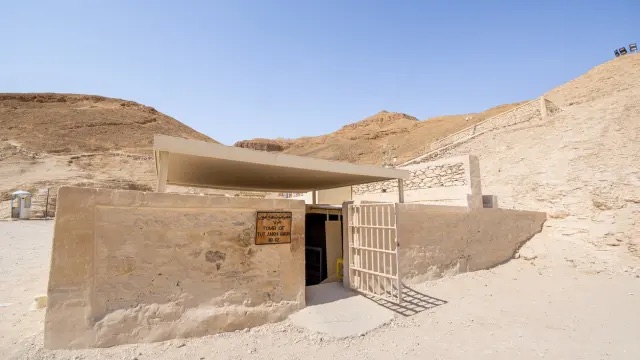
Why the Layout of Tutankhamun’s Tomb Matters
One of the more interesting details concerns the architecture of KV62.
The researchers argue that the layout does not fit neatly with the typical design of royal tombs from the period.
The direction of the turns inside the tomb is particularly interesting. According to the study, visitors leaving Tutankhamun’s burial chamber encounter a series of leftward turns, while many other royal tombs from the same period follow a different orientation.
The researchers argue that KV62’s plan more closely resembles the architectural pattern associated with an 18th-Dynasty queen.
That observation fits with Reeves’ earlier argument that the tomb may have originally been designed for a woman before being adapted for Tutankhamun.
It is an intriguing clue, although by itself it cannot identify the original owner of the structure.
The Mystery Is Far From Solved
There is an important reason to remain cautious.
Geophysical anomalies do not automatically mean that archaeologists have discovered rooms, corridors or a royal tomb. Changes in the geology beneath the Valley of the Kings can produce unusual signals, and interpreting those signals is complicated.
The researchers themselves describe some of their proposed structures as highly speculative.
Other experts have also urged caution. Ray Johnson, a former director of the Epigraphic Survey at the Institute for the Study of Ancient Cultures, described the results as extremely interesting but noted that even if chambers are present, there is no guarantee they contain Nefertiti’s burial.
The possible spaces could have another purpose—or they could have been damaged by natural processes such as flooding.
Earlier radar investigations of Tutankhamun’s tomb have also demonstrated just how difficult it can be to interpret underground signals. In 2018, researchers concluded that earlier indications of hidden chambers behind the burial chamber were not supported by their subsequent radar survey. (National Geographic)
That history makes the new findings especially important, but also explains why archaeologists are reluctant to announce a discovery before physically investigating the anomalies.
Researchers Want to Look Inside
The only way to determine what lies beneath the ground is to investigate the suspected spaces directly.
The research team is seeking permission from Egyptian authorities to drill a small opening from above and insert cameras into the suspected structures.
Such a method could allow researchers to see whether the anomalies correspond to actual chambers or passageways without opening or damaging the famous walls of Tutankhamun’s tomb.
If permission is granted, the drilling could potentially begin as early as November 2026, according to reports cited by Smithsonian and Nature. (Smithsonian Magazin
That could turn an intriguing geophysical signal into something much more tangible.
Could Nefertiti Really Be There?
At this stage, the answer is still unknown.
Nefertiti remains one of ancient Egypt’s great archaeological mysteries. Her famous painted limestone bust is one of the most recognizable representations of an ancient Egyptian ruler, yet the location of her burial has never been securely established.
Tutankhamun’s tomb, meanwhile, has already produced an extraordinary amount of information about the final years of the Amarna period.
If additional chambers really do exist nearby, they could potentially provide new evidence about how royal burials were organized during one of the most complicated periods of ancient Egyptian history.
And if those chambers contained a royal burial connected to Nefertiti, the significance would be enormous.
But archaeologists still have to take the next step.
For now, the underground anomalies are clues—not a confirmed hidden tomb.
The coming investigation could reveal ancient chambers, a forgotten passageway, or simply natural rock formations that produced convincing signals. Until a camera—or archaeologist—actually enters one of those spaces, the mystery remains open.
For more than 3,000 years, Nefertiti’s final resting place has remained hidden.
It may be that the answer is still waiting only a short distance beyond the tomb of the boy king who followed her generation.
Written by Hidden Civilizations Editorial Team