Imagine standing on dry, flat farmland, surrounded by bustling roads and modern settlements just a short drive west of Bangkok. Now, picture peeling back the layers of earth to find a colossal, 40-foot marine leviathan resting quietly beneath the clay.
This is not the premise of science fiction. In the Samut Sakhon province of Thailand, researchers unearthed one of the most astonishing paleontological finds in modern Asian history: an exceptionally preserved, subfossil Bryde’s whale skeleton resting nearly 12 kilometers (7.5 miles) inland from the modern coastline.
Dating back an estimated 3,000 to 5,000 years, this silent sentinel from the past has opened a profound window into the shifting geography, climate history, and prehistoric marine ecosystems of Southeast Asia.
A Giant Interrupted: Anatomy of a Rare Discovery
The discovery itself began like many great archaeological surprises: by pure accident. In late 2020, construction and water resource management work in the Ban Phaeo district of Samut Sakhon revealed unusual shapes protruding from the earth. Paleontologists and marine researchers rushed to the site, carefully unearthing what would turn out to be an almost miraculous preservation.
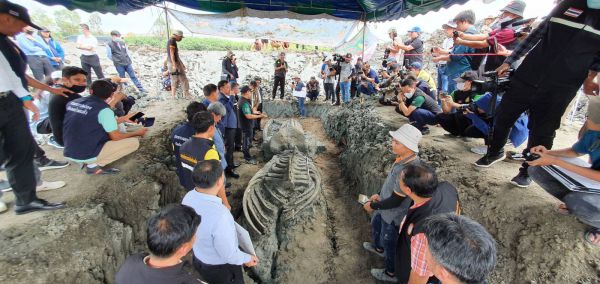
Credit: Reuters / Soe Zeya Tun — licensing required for Reuters images.
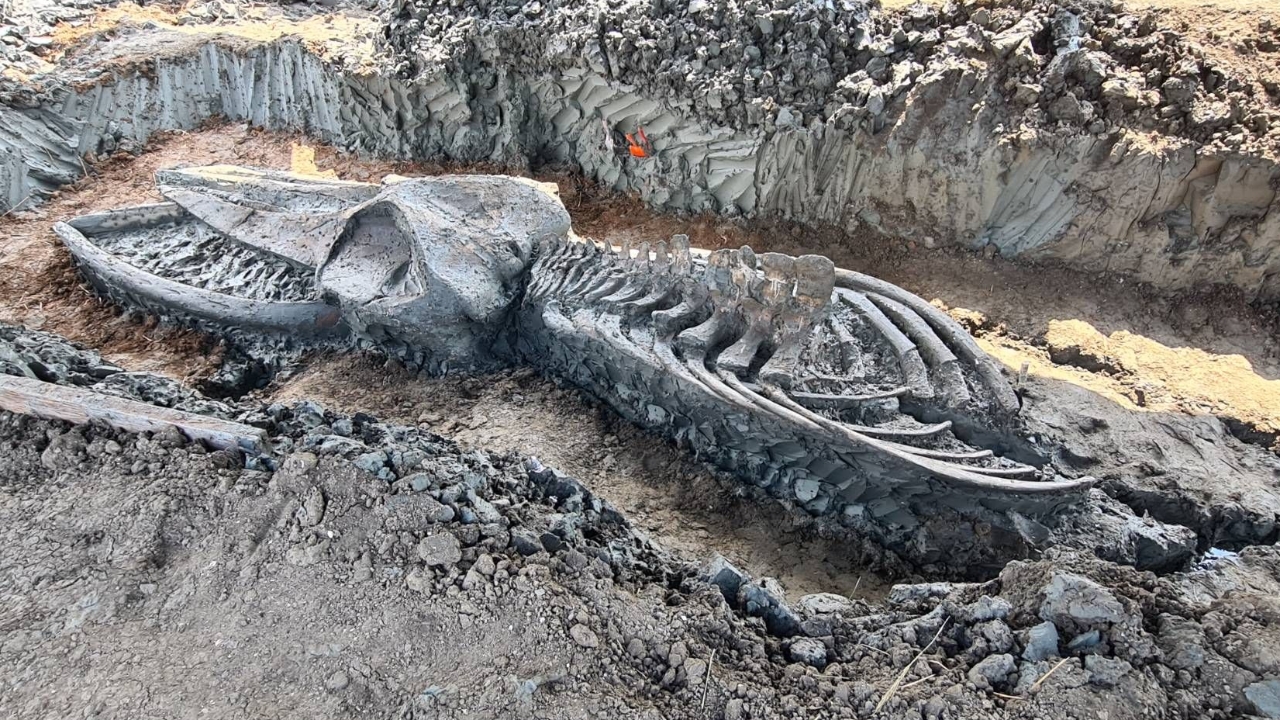
Unlike many fragmentary fossils that require guesswork to piece together, over 80 percent of this magnificent skeleton was recovered completely intact. The excavation revealed:
A Massive Skull: Measuring a staggering 3 meters (nearly 10 feet) in length.
The Spinal Column: 19 complete, immaculate vertebrae stretching out the skeletal frame.
Appendages and Support Structures: Five well-preserved ribs, a shoulder blade, and delicate flippers.
Experts identified the specimen as a Bryde’s whale (Balaenoptera edeni), a majestic creature that still gracefully plies the warm tropical and subtropical waters of the Gulf of Thailand today. Spanning a total length of 12.5 meters (nearly 41 feet), the sheer scale of the skeleton commands awe, painting a vivid picture of a massive ocean dweller that swam these waters millennia ago.
Rewriting the Map: Proof of Higher Seas
Beyond its value to marine biology, the location of the skeleton is arguably its most thrilling aspect. Finding a 41-foot marine mammal deep inland forces scientists to dramatically recalibrate their understanding of historical geography.
During the mid-Holocene period, thousands of years ago, global climate fluctuations drove sea levels significantly higher than they are today. The Gulf of Thailand extended much further inland, submerging vast stretches of land that are now bustling provinces and agricultural hubs.
“A large subfossil whale dated thousands of years ago near Bangkok provides undeniable physical evidence of where the sea’s boundary once lay,” notes Marcus Chua, a researcher from the National University of Singapore.
Previously, researchers relied on microscopic marine deposits, small fossilized shells, or crab remains to map ancient shorelines—evidence that was sometimes ambiguous or prone to being displaced by human activity. A massive whale skeleton, however, cannot be moved casually. It marks the precise, undeniable footprint of an ancient ocean floor.
A Time Capsule of Ancient Ecosystems
The whale did not rest alone. Entombed in the same clay layers alongside the skeleton were delicate micro-fossils, ancient clam shells, and razor-sharp shark teeth.
This rich micro-matrix acts as an ancient ecological snapshot. By analyzing the chemical signatures of the surrounding sediment and accompanying marine organisms, scientists can reconstruct:
Historical Ocean Temperatures: Understanding how warm or cool the Gulf of Thailand was during past warming periods.
Prehistoric Food Webs: Identifying what prey species thrived alongside the whale.
Biodiversity Baselines: Comparing ancient marine health with modern, human-impacted aquatic environments.
Looking to the Future Through the Past
As coastal communities worldwide grapple with the realities of modern climate change and rising sea levels, discoveries like the Samut Sakhon whale carry a poignant modern resonance. They serve as natural historical records of how dramatically planetary coastlines can shift over time.
Safely housed and preserved for scientific study, the Samut Sakhon Bryde’s whale bridges the gap between deep history and modern environmental science. It stands as a powerful reminder that the earth is dynamic, constantly reshaping its shores, and that beneath our feet lie epic stories of worlds long vanished.
Written by Hidden Civilizations Editorial Team