
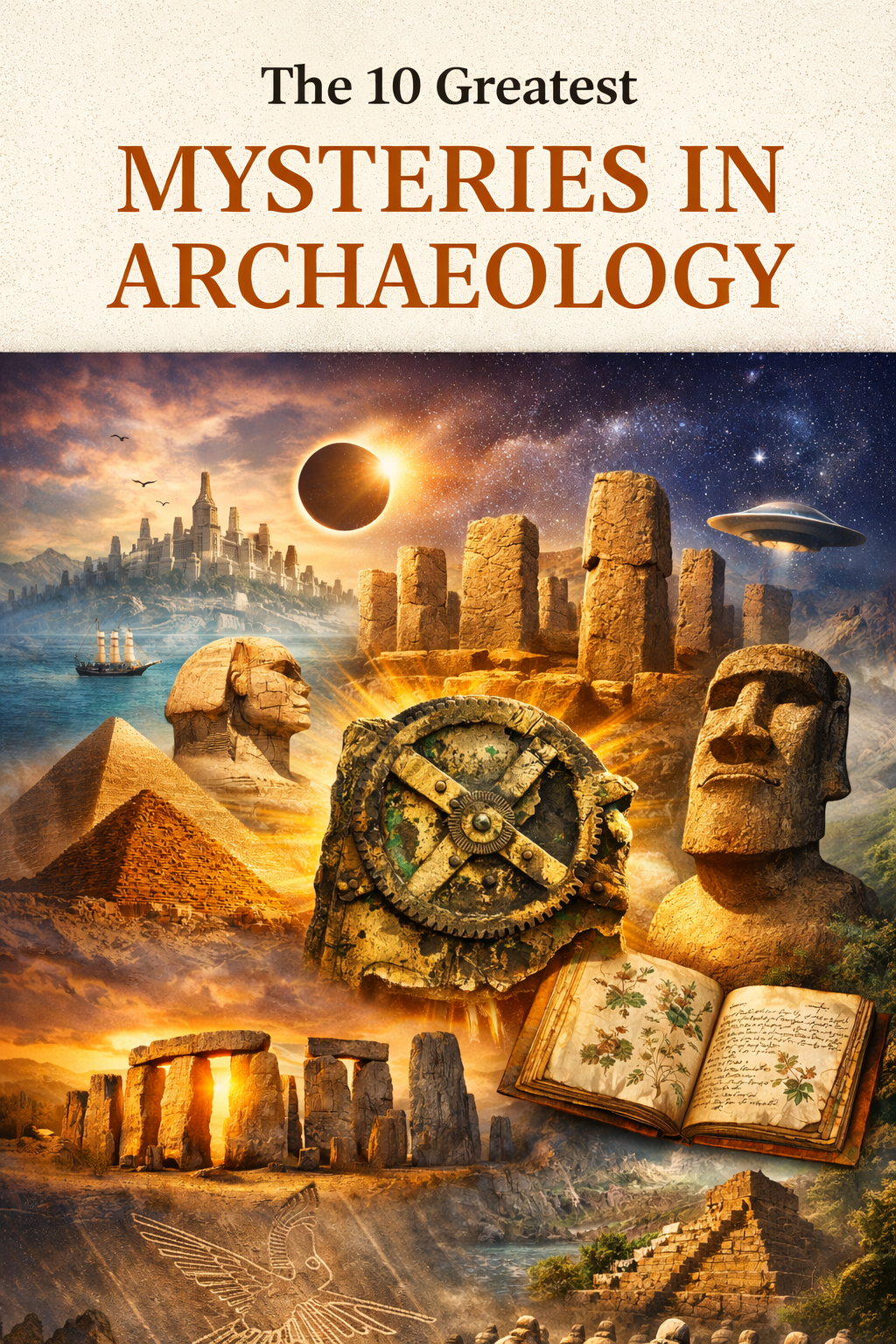
Archaeology is often seen as a science of discovery—digging up the past and revealing the stories of ancient civilizations. Yet despite centuries of research, some of the most fascinating archaeological discoveries remain unsolved mysteries. These puzzles challenge historians, scientists, and archaeologists alike, forcing us to reconsider what we know about human history.
From lost cities buried beneath jungles to ancient monuments whose construction still baffles modern engineers, archaeology is full of questions that remain unanswered. Here are ten of the greatest mysteries in archaeology that continue to intrigue researchers and enthusiasts around the world.
1. The Purpose of Stonehenge
Few prehistoric monuments are as famous or mysterious as Stonehenge. Built between approximately 3000 and 2000 BCE, this massive stone circle remains one of the most iconic archaeological sites in the world.
Archaeologists believe Stonehenge served some kind of ceremonial or religious purpose, but its exact function remains uncertain. Some researchers suggest it was an ancient astronomical observatory aligned with the solstices, while others believe it may have been a burial site or a center for healing rituals.
Another mystery is how prehistoric people transported the enormous stones. Some weigh up to 25 tons and were moved from quarries located many kilometers away. Considering the limited technology available at the time, the logistics behind this project remain remarkable.
Despite decades of excavation and research, the true purpose of Stonehenge continues to be debated.
2. The Lost City of Atlantis
One of the most famous lost civilizations in history is Atlantis. First mentioned by the ancient Greek philosopher Plato around 360 BCE, Atlantis was described as a powerful and advanced civilization that mysteriously sank into the ocean.
Many archaeologists believe Atlantis is simply a myth or allegory created by Plato to illustrate philosophical ideas. However, others have proposed possible real-world locations that could have inspired the story.
Some researchers suggest the legend may be connected to the catastrophic eruption on the island of Santorini, which devastated the Minoan civilization around 1600 BCE.
Whether Atlantis ever truly existed remains one of the greatest debates in archaeology.
3. The Construction of the Egyptian Pyramids
The pyramids of Giza are among the most impressive structures ever built by ancient humans. The largest of these, the Great Pyramid of Giza, was constructed more than 4,500 years ago.
Despite extensive study, scholars still debate how the ancient Egyptians were able to build such massive structures with remarkable precision. The pyramid contains over two million limestone blocks, some weighing several tons.
Traditional theories suggest workers used ramps, sledges, and large labor forces. However, the exact construction techniques remain uncertain. Modern engineers continue to study the pyramids to better understand how this incredible feat of engineering was achieved.
4. The Nazca Lines
In the deserts of southern Peru lie the enormous geoglyphs known as the Nazca Lines.
Created by the Nazca culture between 500 BCE and 500 CE, these giant figures depict animals, plants, and geometric shapes that are only fully visible from the air.
The purpose of these massive designs remains unknown. Some archaeologists believe they were part of religious ceremonies or rituals connected to water and fertility. Others think they may have functioned as astronomical markers.
Regardless of their purpose, the Nazca Lines demonstrate a remarkable level of planning and coordination by ancient societies.
5. The Voynich Manuscript
One of the strangest historical artifacts ever discovered is the Voynich Manuscript.
Discovered in 1912 by book dealer Wilfrid Voynich, this mysterious manuscript contains strange illustrations of plants, astronomical diagrams, and text written in an unknown script.
Despite more than a century of attempts by linguists, cryptographers, and historians, no one has been able to decipher the language used in the manuscript. Some researchers believe it may be a coded scientific text, while others suspect it could be an elaborate hoax.
The Voynich Manuscript continues to puzzle experts and remains one of the world’s most famous unsolved linguistic mysteries.
6. The Terracotta Army
In 1974, farmers in China accidentally uncovered one of the greatest archaeological discoveries of the twentieth century: the Terracotta Army.
Located near the tomb of Qin Shi Huang, the site contains thousands of life-sized clay soldiers, horses, and chariots buried to protect the emperor in the afterlife.
Each statue is unique, with distinct facial features and armor. Archaeologists are still studying how these figures were produced in such large numbers with incredible detail.
Even more mysterious is the emperor’s burial chamber itself, which has not yet been fully excavated due to concerns about preserving the site.
7. The Disappearance of the Maya Civilization
The Maya civilization was one of the most advanced cultures in the ancient Americas, known for its writing system, mathematics, and astronomy.
However, around the 8th and 9th centuries CE, many major Maya cities were suddenly abandoned. This collapse remains one of archaeology’s biggest puzzles.
Scholars have proposed several explanations, including prolonged droughts, warfare, political instability, and environmental degradation. It is likely that multiple factors contributed to the decline.
Even today, archaeologists continue to uncover new Maya sites hidden beneath dense jungle, providing clues about this mysterious collapse.
8. The Antikythera Mechanism
In 1901, divers exploring a shipwreck near the Greek island of Antikythera discovered an extraordinary artifact now known as the Antikythera Mechanism.
This complex device, made of bronze gears, is believed to date from around 100 BCE. Scientists believe it was used to predict astronomical events such as eclipses and planetary movements.
Often described as the world’s first analog computer, the Antikythera Mechanism demonstrates an astonishing level of technological sophistication for the ancient world.
How such advanced knowledge was developed—and why similar devices have not been found—remains a mystery.
9. The Easter Island Statues
The remote Pacific island known as Easter Island is famous for its giant stone statues called Moai.
Created by the Rapa Nui people, these statues can weigh up to 80 tons and stand several meters tall.
One of the greatest mysteries surrounding the Moai is how the island’s inhabitants transported them across the island without modern technology. Some theories suggest they were rolled on logs, while others propose they were “walked” upright using ropes.
Equally puzzling is why the civilization that created them eventually collapsed.
10. Göbekli Tepe: The Oldest Temple
One of the most groundbreaking archaeological discoveries of the modern era is Göbekli Tepe.
Dating back to around 9600 BCE, this site is thousands of years older than the pyramids of Egypt and Stonehenge.
Göbekli Tepe consists of massive stone pillars arranged in circular structures, decorated with carvings of animals and symbolic figures. The site was built by hunter-gatherers long before the development of agriculture.
This discovery has challenged traditional theories about the origins of civilization. It suggests that organized religion and monumental architecture may have existed before farming societies.
Why Göbekli Tepe was built—and why it was deliberately buried—remains a fascinating mystery.
Conclusion
Archaeology continues to reveal extraordinary discoveries about humanity’s past, but many questions remain unanswered. These mysteries remind us that history is not a completed story; it is an ongoing investigation.
With new technologies such as satellite imaging, DNA analysis, and advanced dating techniques, archaeologists are uncovering clues that were previously impossible to detect. Perhaps one day some of these great mysteries will finally be solved.
Until then, they continue to inspire curiosity, debate, and exploration—keeping the past alive in the imagination of researchers and history lovers around the world.
It’s amazing how many questions still linger after all this time. The idea of lost cities really gets you thinking about what we don’t know.